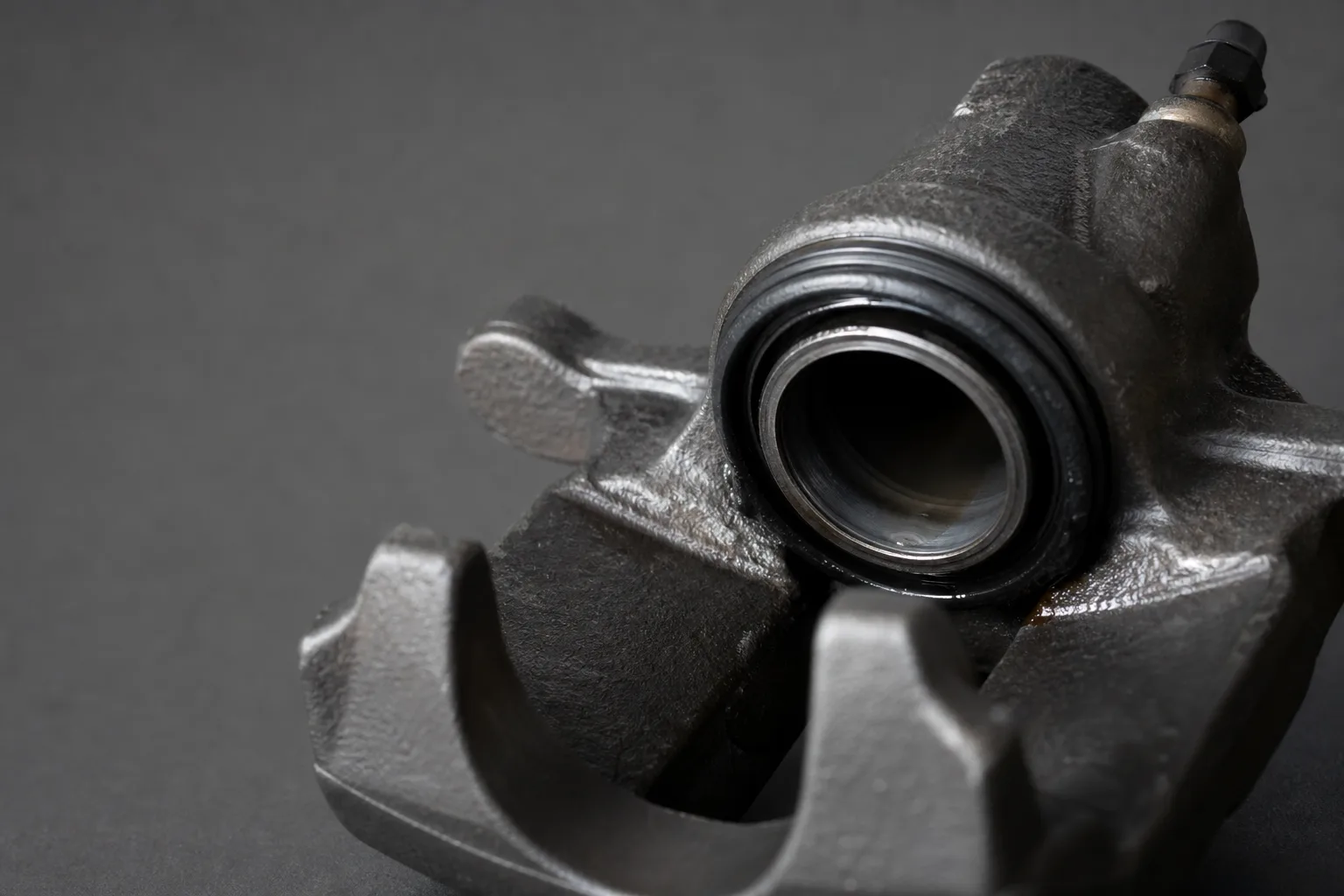
Four common leak points share one symptom, and the repair bill for each differs by an order of magnitude, so find the source before ordering anything.
The cheapest repair on this list costs about a dollar in parts, and the most expensive runs past two hundred with labor included, yet all four present identically: a damp caliper, a smell of brake fluid, and a slow drop in the reservoir. Ordering a remanufactured unit on the strength of a wet casting is a common and expensive habit. It works, in the sense that the leak usually stops, but it can mean buying a caliper to fix a copper washer. Twenty minutes of diagnosis is what separates those two outcomes, and the twenty minutes is free.
Clean everything first, because fluid lies about where it came from
Brake fluid creeps. It runs down the caliper body, wicks along the hose, collects on the inside of the wheel and gets flung outward by rotation, so the wettest spot is very often the lowest spot rather than the source. Spray the whole assembly with brake cleaner, wipe it dry with a rag, and get the hose, the banjo fitting, the bleed nipple and the piston dust boot visibly clean. Then drive normally for a day, or have someone press the pedal hard several times while the wheel is off, and look again with a flashlight.
Four places fluid leaves a brake corner
The banjo bolt joint at the top of the caliper seals with two crush washers, one above the fitting and one below, and those washers are single-use. A joint that was disturbed for pad work and reassembled with the old washers will weep under pressure and stay dry at rest, which makes it the easiest leak to misread. The bleed nipple leaks around its threads or from a cracked seat, usually after someone leaned on it with a poorly fitting wrench. The piston seal shows up as fluid inside the dust boot, on the pad backing plates, and streaked down the rotor face.
The flexible hose is the fourth candidate and the one people skip. Hoses fail at the crimped ferrules, at the chafe point where they pass a bracket, and internally in a way that produces no leak at all but a caliper that drags. A hose that is bulging, weeping at a crimp, or cracked deeply enough to show the reinforcement layer needs replacing regardless of what else you find, because the National Highway Traffic Safety Administration oversees the safety standards that brake hoses are built to, and a hose that has already failed once is not a component to nurse along.
What each answer actually costs
Copper crush washers are sold in pairs for a few dollars, and the whole job is one bolt, two washers and a bleed at that corner. A bleed nipple is comparably cheap, though a seized one that snaps off changes the arithmetic immediately and can turn a five-dollar part into a caliper purchase anyway. A rebuild kit with piston seal, dust boot and slide pin boots typically lands in the twenty to forty dollar range, and demands that the bore be clean, unpitted and free of corrosion pockets. A remanufactured caliper with a core charge sits well above that, and a new one above that again.
The labor overlaps heavily, which is what makes the parts decision worth getting right. Whichever component you replace, the corner comes apart, the fluid gets bled, and the wheel goes back on. Mechanics sometimes describe a corroded caliper as fit only for the Casket, and for a seized piston in a pitted bore that judgment is correct, but it gets applied far too freely to units that need nothing more than a fresh pair of washers. The honest comparison is parts cost against the risk of doing the job twice, not against the shop rate, since you are paying that either way.
The tests that separate the four
With the wheel off and the assembly clean, have someone hold firm pedal pressure while you watch the banjo joint and the hose with a light. A washer leak beads at the joint within seconds under pressure and stops when the pedal is released. Peel back the piston dust boot with a pick: any fluid trapped in there is a piston seal, full stop, and no amount of retorquing the banjo bolt will change that. Flex the hose gently along its length and check the crimps. Wipe the bleed nipple, then crack it and retighten it to a proper torque.
When the answer is the whole caliper
Pull the piston out during a rebuild and the bore tells you what to do next. Smooth bore, light staining, clean seal groove: a kit will hold. Pitting you can catch with a fingernail, a scored piston, or corrosion under the seal groove means the new seal has nothing to seal against, and the leak returns within a season. Slide pins frozen in their bores, a stripped bleed nipple thread, and a cracked casting all point the same direction. Reaching that conclusion after inspection costs you a rebuild kit; reaching it by guessing costs you a caliper you did not need.
Diagnosis before purchase is the whole discipline here. Clean the corner, pressurize it, look at four specific places, and buy the part the evidence names.